An essay on what the bill formalizes, what crypto is actually used for, and the question no one ever answered
Part One: The Missing Use Case
1. The Question No One Answered
Don't ask what crypto is designed to do. Ask what people are actually doing with it. Most of the volume — measured in dollars — is just trading crypto for other crypto, or buying crypto to trade later. After fifteen years, the connections to anything outside the ecosystem (payments, lending, anything a bank already does faster and cheaper) are still narrow.
Over an eight-week stretch in 2022, three of the field's most credible figures sat down on friendly podcasts and got asked, plainly, to name the use case. Packy McCormick (a VC) suggested putting a house on the blockchain so it could be borrowed against from a global pool of lenders. Zach Weinberg (an entrepreneur) walked the scenario through to its end: the borrower defaults, the lender holds a cryptographic record, takes it to the sheriff, and then what?
Zach: ...you've just recreated the entire mortgage infrastructure that already exists today.
Packy: ...on the blockchain!
Zach: But that's exactly right. Then I'm lost as to why the "on the blockchain" part matters... every other step in the process is essentially the exact same thing you have to do in the real world.
Packy: I got wrecked on the mortgage example. I've never thought through that one before.
- Cartoon Avatars, June 2022
Six weeks earlier, Tyler Cowen had put a similar question to Marc Andreessen, whose firm has invested more in crypto than anyone else's: what would crypto do for podcasts? Andreessen kept backing off as the question pressed:
Tyler: What's the concrete advantage of Web 3.0 (crypto) for podcasts?... Why is this a better podcast if it's done through web 3.0?
Marc: Yeah, well the most obvious thing is just money. You... you just don't get paid.
Tyler: ...as a percentage of GDP, they sound like really tiny advantages.
Marc: Well, it depends on a percentage of GDP. Everything is tiny compared to healthcare...
- Conversations with Tyler, 2022
And on Bloomberg's Odd Lots, Sam Bankman-Fried — then the industry's most credible-looking figure, later its most famous felon — was asked how DeFi yield farming made any money at all:
Sam: You start with a company that builds a box... pretend it does literally nothing. It's just a box. There's a token... given out as yield... X token price goes way up... and then it goes to infinity. And then everyone makes money.
Matt: ...that was so much more cynical than how I would've described farming. You're just like, well, I'm in the Ponzi business and it's pretty good.
- Odd Lots, Bloomberg, April 2022
Six months after that taping, FTX collapsed and took about $8 billion of customer money with it. Bankman-Fried is now serving twenty-five years. None of these moments by itself proves crypto has no real uses. But they set a floor. On friendly ground, with sympathetic interviewers, given every chance to make the case, the field's best people couldn't.
Fifteen years is long enough to stop arguing and look at the record. Take the best-funded, most-hyped project in every real-world use case crypto has claimed — supply chains, carbon offsets, identity, voting, music, gaming, storage, payments — and ask one thing about each: does anyone outside the crypto bubble actually use it, legally, in a way that needs a blockchain?
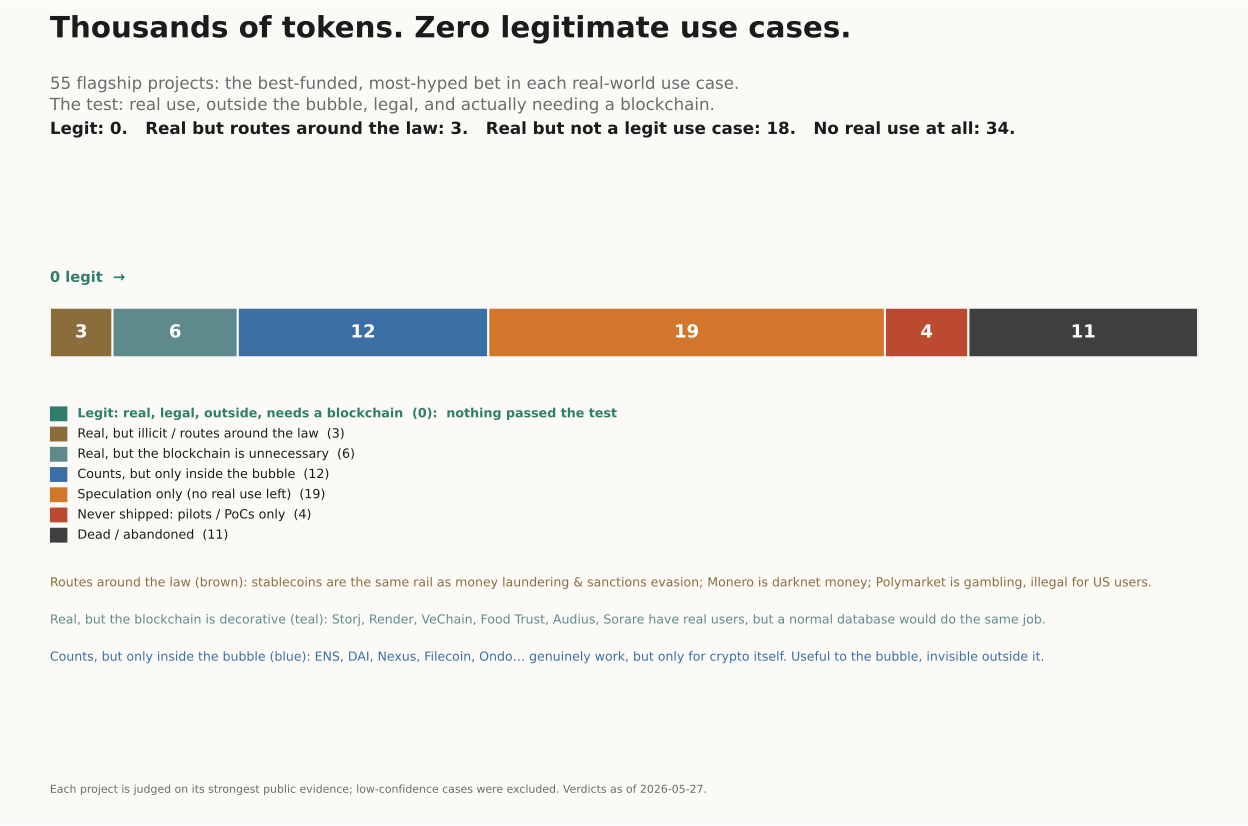
Fifty-five flagship projects, sorted by who actually uses them. Every project and verdict is listed in the appendix.
None of the fifty-five pass. Three have real users, but they work by routing around the law (more on that in the next section). Six have real users and don't need a blockchain — an ordinary database would do the same work. Twelve genuinely do something, but only for crypto itself: .eth names that resolve inside crypto wallets, a stablecoin that backs crypto loans, insurance against crypto hacks. The other thirty-four are speculation, dead pilots, or just dead. The 2022 interviews weren't anomalies. They were what the floor of this industry actually looks like.
2. What It Actually Does
There are real uses outside the bubble. The list is short, and the entries on it share an uncomfortable feature. Reserve-backed stablecoins do move dollars across borders cheaply, and in countries with collapsing currencies people genuinely use them to hold value. But the wire system is slow and expensive for a reason — banks have to run KYC checks, file suspicious-activity reports, and screen sanctions lists. The Venezuelan saver using USDT is doing the same operation, mechanically, as a Russian oligarch evading sanctions, a North Korean hacker laundering stolen funds, a ransomware crew getting paid, or a fentanyl-precursor supplier in Wuhan billing a US distributor. Blockchains don't tell them apart. They just cut out the institution that was supposed to.
Chainalysis estimates the illicit share of crypto volume in the low single digits — which is still tens of billions of dollars a year, and the segment with the clearest product-market fit. Regular banks have illicit flows too, but they have a working enforcement system pointed at them. Crypto is partly pitched on the fact that it doesn't. That's why the uses closest to legitimate on the scorecard are the ones that route around the law. Measured in dollars, that's the real answer to what crypto is for. And as Part Two will show, it's the answer this bill can't really touch.
3. Why the Money Came Anyway
If the use case never arrived, why did the capital? The answer isn't enthusiasm. It's structure. A normal venture bet locks up for five to ten years and pays out only when a real, revenue-generating company goes public. A token launch sidesteps all that. The firm buys tokens at a steep discount. Within months they're trading publicly. Retail buyers pay full price. When the early lockup expires, the firm sells. The exit is done — no revenue, profit, or working product needed. The company underneath only has to produce a token retail buyers will buy.
So the use case never had to actually exist. It just had to sound plausible while the launch was being marketed. Andreessen Horowitz raised crypto funds of $300M in 2018, $515M in 2020, $2.2B in 2021, and $4.5B in 2022. Across that whole run, the question that mattered wasn't whether the technology worked. It was whether retail would buy the next token. The people publicly evangelizing crypto's promise didn't really need it to come true, in their own financial models. McCormick the explainer wrote the optimistic essays. McCormick the investor admitted on tape that he'd never thought the mortgage case through. The evangelism was the marketing wrapper. And the firms that profited from this machine are now the biggest donors to the political operation in Part Two.
4. The Wreckage
The use cases may be narrow, but the failure record isn't. Since 2021, Molly White has been logging crypto's disasters; her running total as of May 2026 is about $81 billion lost to hacks, scams, and collapses. The losses come in a few recurring shapes. Worth keeping each in mind — because Part Two is fairly judged on how many of them it actually would have prevented.
The biggest category is centralized exchanges and lenders that simply lost customer money: FTX (~$8.7B), Genesis (~$5.1B), Celsius, Voyager, BlockFi. The pattern is that the company shows you a balance on a website while quietly spending the actual coins. The TerraUSD de-peg wiped out $40 billion of market value in days — though only a few billion in real cash had been paid in — and rolled through everyone holding it. Bridge hacks like Axie's $625M (stolen by North Korea's Lazarus Group and laundered through DeFi) showed that smart-contract pools are the most exploitable structure in the field. Rug pulls and foreign exit scams (Africrypt ~$3.6B, Thodex ~$2B) account for most of the rest, with recovery rates near zero.
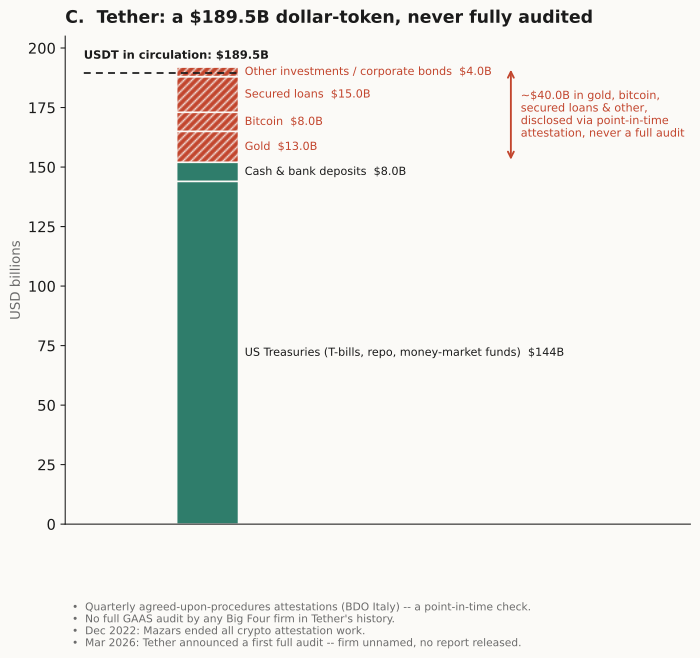
One failure isn't a single episode but a structural pattern, and it's the one that matters most for what the bill can do. Tether's USDT — about $190 billion in circulation, and the main settlement currency for the sanctions-evading flows mentioned earlier — has never had a full audit. For its entire history Tether has put out quarterly attestations: a snapshot of one moment in time, not the going-concern examination an actual audit produces. Mazars walked away in 2022. A Big Four firm announced an engagement in 2026 and still hasn't produced anything.
About $40B of Tether's reserves sit in gold, bitcoin, secured loans and "other," disclosed only by attestation, never audited. Charts and sources.
Part Two: The CLARITY Act
5. What the Bill Does, and What It Can't Reach
US law sorts investments into securities (regulated by the SEC) and commodities (which go to the much smaller, less-funded CFTC). For a decade the SEC argued in court, case by case, that most token sales are unregistered securities under the 1946 Howey test — money put in, a shared enterprise, profit expected to come from someone else's work. The Digital Asset Market Clarity Act (H.R. 3633), passed by the House in July 2025 and voted out of Senate Banking 15-9 in May 2026, settles that fight by inventing a new category: the digital commodity. Once a chain is deemed sufficiently decentralized, its tokens go to the CFTC.
Where the bill bites, it bites real problems. Registered exchanges have to segregate customer assets and use qualified custodians — the one provision that would have made FTX's raid on customer funds illegal from day one. Insider lockups stop founders from dumping their allocation for a year and cap sales after that, directly targeting rug pulls. When an exchange fails, customer property has to come back before other creditors get paid. For centralized US operators, these are real protections, and better than no bill at all.
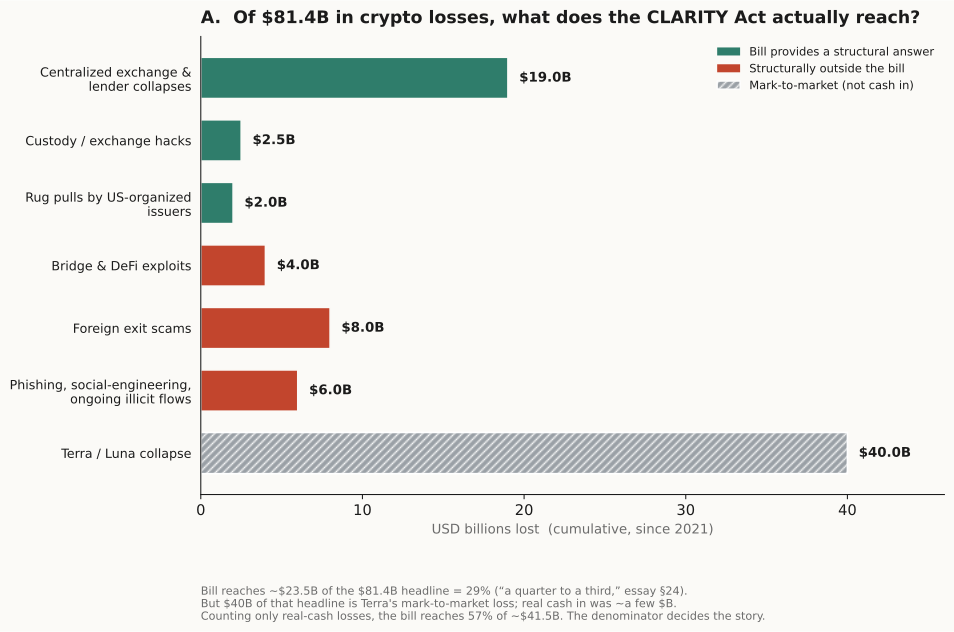
The problem is what sits outside the perimeter on purpose. DeFi developers, liquidity pools, and wallet software get an explicit carve-out, so the bridge hacks and the laundering rails stay outside the bill's reach. Foreign exit scams are still foreign. Tether, incorporated in El Salvador, doesn't have to do anything. And because the bill regulates structure rather than price, a Terra-style de-peg also falls outside its scope. Held up against the $81 billion record, the coverage is partial:
The bill gives a real structural answer to roughly a quarter-to-a-third of the losses; the rest is outside its reach by design. Charts and sources.
This is a market-structure bill, not a comprehensive law. Most of its real detail is punted to two or three years of SEC and CFTC rulemaking. The thing it conspicuously doesn't address is the cross-border, sanctions-evading, AML-evading volume that (per Part One) is the field's clearest real-world use. The part of crypto the bill does regulate is the part that overlaps with ordinary finance — and that part is smaller, and shrinking.
6. Why It's Passing Anyway
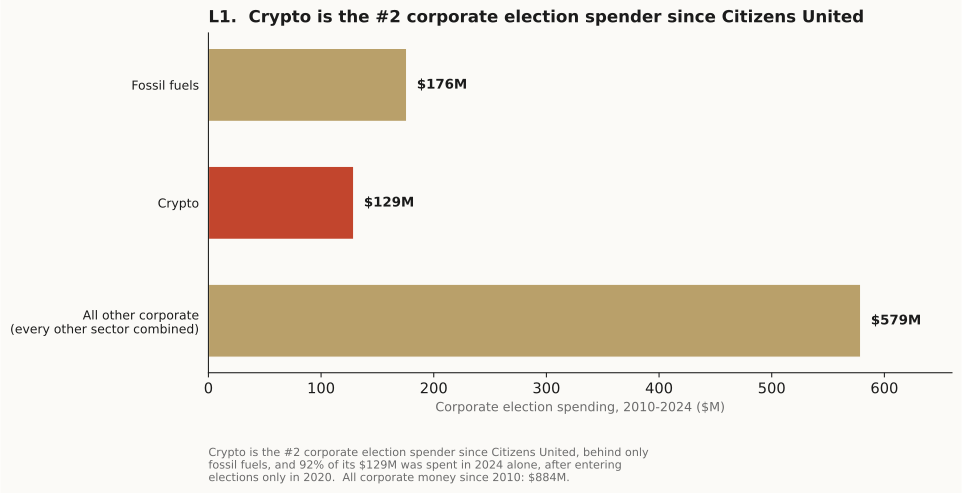
An industry that never made its case on the merits is getting a bill anyway, on a bipartisan vote, because it stopped arguing the case and bought influence instead. Before 2018, crypto barely registered as a federal political spender. In the 2024 cycle it put about $119 million of corporate-treasury money — direct contributions from for-profit companies into super PACs — into federal elections. That was roughly 44% of all corporate-treasury contributions that year, according to Public Citizen. It's a narrower measure than the industry-affiliated totals you'll see on OpenSecrets, which include individual donors and trade PACs. The money flowed through a few super PACs (Fairshake and its affiliates), which spent about $133 million across 58 races. Only fossil fuels has spent more since Citizens United.
Crypto became the #2 corporate election spender since 2010, and 92% of that arrived in 2024 alone. Lobby charts and sources.
The strategy wasn't persuasion. It was consequence. Crypto-backed candidates won 53 of 58 targeted races, about 91% — though the headline number is flattered by a deliberate playbook of dominating primaries in safe-seat districts where the general election was already settled. Padding the win column wasn't really the point. The point was that the PACs spent over $40 million to retire Senator Sherrod Brown, the Banking Committee's most consistent skeptic, and $10 million against Katie Porter, who wasn't even particularly anti-crypto. The message was for everyone else who was watching. Once in office the administration delivered: dropped the SEC's case against Coinbase, disbanded the Justice Department's crypto-enforcement team, signed the GENIUS Act stablecoin law in 2025. Fairshake is already sitting on roughly $193 million for 2026.
On top of the institutional capture is a personal one. The President's family launched World Liberty Financial (which includes a governance token and a stablecoin) and the $TRUMP memecoin. The memecoin's own paperwork shows most of the supply held by Trump entities, and the project sold an exclusive dinner to its top holders. That's a sitting president selling access through a token he controls — about as pure an anti-use-case as you can get. Separately, the Commerce Secretary's firm, Cantor Fitzgerald, holds a stake in Tether and custodies some of its reserves — while Treasury and Justice are the agencies supposed to be policing the sanctions evasion USDT enables. The bill adds no new ethics provisions for any of this, which is the central Democratic objection.
Then there's enforcement. A regulatory framework is only as good as the agencies running it, and the people who'll be running this one are the same ones who spent the past year backing away from the rules that already existed. Laws on paper aren't the same as laws in practice.
7. A Sober Reading
The CLARITY Act does some genuinely useful things. It writes down rules for centralized US operators. It tells exchanges what they're not allowed to do with customer money. It gives bankruptcy courts a clean answer for the next FTX. For the quarter-to-a-third of the wreckage that landed on ordinary users of US-facing platforms, that's better than no bill.
The rest sits outside the bill on purpose. The de-pegs, the DeFi exploits, the foreign scams, and most of all the ongoing flow of sanctions-evading, ransomware-funding, fentanyl-paying money through USDT and DeFi — which is specifically built to avoid the registered intermediaries the bill regulates. That last category is what all of Part One was building toward. If crypto's clearest real-world use is routing around US laws on laundering, sanctions evasion, and corruption, then a market-structure bill that leaves those flows alone isn't really addressing what crypto is for.
What gets a federal framework is the version of crypto that resembles ordinary finance. The version that, measured in dollars, is the real-world answer to the 2022 question — what is this technology actually for? — doesn't get touched. Congress is writing rules for a question the industry never raised. The one the industry was asked back in 2022 is still sitting there.
References
The bill
H.R. 3633, Digital Asset Market Clarity Act of 2025, full text as reported by the House Financial Services and Agriculture Committees: govinfo.gov/content/pkg/BILLS-119hr3633rh/html/BILLS-119hr3633rh.htm. Congress.gov bill page with status: congress.gov/bill/119th-congress/house-bill/3633. House Rules Committee package: rules.house.gov/bill/119/hr-3633.
Trackers and legal analysis
DeFi Rate CLARITY Act fact sheet, the timeline source used here: defirate.com/clarity-act-fact-sheet. Latham & Watkins US Crypto Policy Tracker: lw.com/en/us-crypto-policy-tracker/legislative-developments. Congressional Research Service overview: congress.gov/crs-product/IN12583. Senate Banking Committee fact sheets: banking.senate.gov/newsroom/majority/the-facts-the-clarity-act.
News coverage of the May 14, 2026 Senate Banking markup
CoinDesk on the 15-9 vote: coindesk.com/policy/2026/05/14/clarity-act-clears-u-s-senate-committee-on-its-way-to-a-final-test-in-congress. CoinDesk on the DeFi tweak risk: coindesk.com/news-analysis/2026/05/18/amid-the-clarity-act-fanfare-is-some-worry-how-a-last-minute-deal-may-punch-defi. CoinDesk on the Tillis-Alsobrooks text: coindesk.com/policy/2026/05/01/clarity-act-text-lets-crypto-firms-offer-stablecoin-rewards-while-shielding-bank-yield.
The three exchanges
Original Zach Weinberg summary tweet, June 20, 2022: twitter.com/zachweinberg/status/1538705680118472705. The mortgage exchange is from Cartoon Avatars EP 15 with Packy McCormick and Ben Thompson, June 2022, at roughly the 8:40 mark; the most-circulated clip is Liron Shapira's repost: x.com/liron/status/1533214640460574720. Packy McCormick's response essay following the debate: notboring.co/p/web3-use-cases-today. The Andreessen exchange is from Tyler Cowen's Conversations with Tyler interview, May 2022; clip circulated by Liron Shapira: x.com/liron/status/1537186589486460928. The SBF/Levine "magic box" exchange is from Odd Lots, Bloomberg, April 25, 2022; full transcript at bloomberg.com/news/articles/2022-04-25/odd-lots-full-transcript-sam-bankman-fried-and-matt-levine-on-crypto.
Regulatory arbitrage as the actual use case
Chainalysis annual Crypto Crime Reports, the primary public source on illicit on-chain volume: chainalysis.com/crypto-crime-report. US Treasury Office of Foreign Assets Control on Tornado Cash and the Lazarus Group: treasury.gov/recent-actions. TRM Labs reporting on USDT-denominated sanctions evasion, ransomware, and fentanyl-precursor flows: trmlabs.com/insights. United Nations Office on Drugs and Crime on crypto in cross-border money laundering: unodc.org/unodc/en/money-laundering.
The exit-flip and venture-capital math
Andreessen Horowitz crypto fund sizes over time: Blockworks on the $4.5 billion fund, May 2022: blockworks.co/news/andreessen-horowitz-launches-largest-crypto-fund-ever; brief history at medium.com/web3-surfers/a-brief-history-of-a16z-crypto-9471d6355b69; CB Insights research breakdown: cbinsights.com/research/a16z-andreessen-horowitz-crypto-blockchain-investments. Token unlock and post-unlock decline analytics: tokenomist.ai and DeFiLlama unlocks: defillama.com/unlocks. On crypto-vs-IPO time-to-liquidity: lopetaku.medium.com/crypto-venture-capital-3-lies-token-unlocks-37e15c658c03.
The crypto lobby
Sludge on first-half 2025 lobbying spending: readsludge.com/2025/07/23/crypto-industry-is-spending-more-on-lobbying-than-ever. OpenSecrets on the 2024 election cycle: opensecrets.org/news/2024/11/the-crypto-trio-how-the-cryptocurrency-industry-has-made-its-mark-on-2024-elections. CNBC on Fairshake's 2026 war chest: cnbc.com/2025/01/30/crypto-pac-fairshake-has-116-million-on-hand-for-2026-elections.html. Public Citizen on Fairshake spending and the 44%-of-corporate-money figure: citizen.org/article/big-crypto-big-spending-2024. CNBC on the $245M operation and the ads-not-about-crypto strategy: cnbc.com/2024/11/05/cryptos-245-million-campaign-finance-operation-funded-non-crypto-ads.html. CoinDesk on the 53-member Congress count: coindesk.com/news-analysis/2024/12/02/crypto-cash-fueled-53-members-of-the-next-u-s-congress. House FIT21 passage: decrypt.co/231930/crypto-lobby-wins-house-passes-fit21. Coinbase Stand With Crypto and the Nashville Bitcoin Conference: TIME, time.com/7049001/crypto-election-2024; Decrypt on Trump's campaign strategist crediting Bitcoin for the 2024 win: decrypt.co/325187/trump-strategist-how-bitcoin-helped-republicans-win-2024-election. SAB 121 rescission and Trump executive order: Jones Day, jonesday.com/en/insights/2025/02/digital-asset-executive-order-and-sab-121-rescission; CNBC, cnbc.com/2025/05/01/trump-rewrites-crypto-rules-first-100-days-industry-sees-180-pivot-.html. Big Tech lobbying comparison (Issue One): issueone.org/articles/big-tech-spent-record-sums-on-lobbying-last-year.
Molly White
Web3 is Going Just Great, the database of crypto disasters that is the source for the $80B figure and the failure-mode categories in Part One: web3isgoinggreat.com. Leaderboard with running total and per-event detail: web3isgoinggreat.com/charts/top. Citation Needed newsletter: citationneeded.news. TRUMP memecoin dinner research: citationneeded.news/trump-memecoin-dinner-guests. Issue 104 on World Liberty Financial: citationneeded.news/issue-104. Citation Needed on the Cantor Fitzgerald and Tether super PAC relationships referenced in section 22: citationneeded.news.
Stablecoin transparency and Tether
BeInCrypto on the attestation-versus-audit distinction and the Mazars departure: beincrypto.com/tether-q2-avoids-full-audit. John Reed Stark (former SEC) on why attestations are not audits: x.com/JohnReedStark/status/1849924874950922744. Tether's March 2026 announcement of a Big Four audit engagement (firm undisclosed at time of writing): coverage at mexc.com/news/979263.